Unified logistics software brings AI closer to operations
Logistics technology is moving towards unified platforms that connect warehouse, transport, order and planning processes. Manhattan Associates is positioning its Active portfolio in that market, offering the applications through a common cloud-native architecture rather than as isolated systems.
The suite covers warehouse management, transportation management, planning, order management and retail operations. Customers can select Essentials, Enterprise or Enterprise Premier packages, allowing smaller organisations to access a reduced feature set while remaining on the same underlying platform. Manhattan is also targeting implementation within 100 days of contract signing, reflecting growing pressure on supply-chain operators to demonstrate rapid returns.
AI with defined operating limits
The company’s approach to artificial intelligence is centred on embedded agents rather than a general-purpose chatbot. Agents for transport planning, scheduling and shipment tracking operate through controlled application programming interfaces. This creates a sandbox in which each agent has access only to specified functions and data, a design intended to limit unintended actions and reduce cyber risk.
Operational teams remain part of the decision process. Manhattan says its software can set rules and guardrails before allowing agents to coordinate routine activity, while human judgement is retained for exceptions and complex decisions. The platform also supports simulations of distribution-centre cyber incidents, helping companies examine alternative fulfilment arrangements if a site becomes unavailable.
Evidence from large supply chains
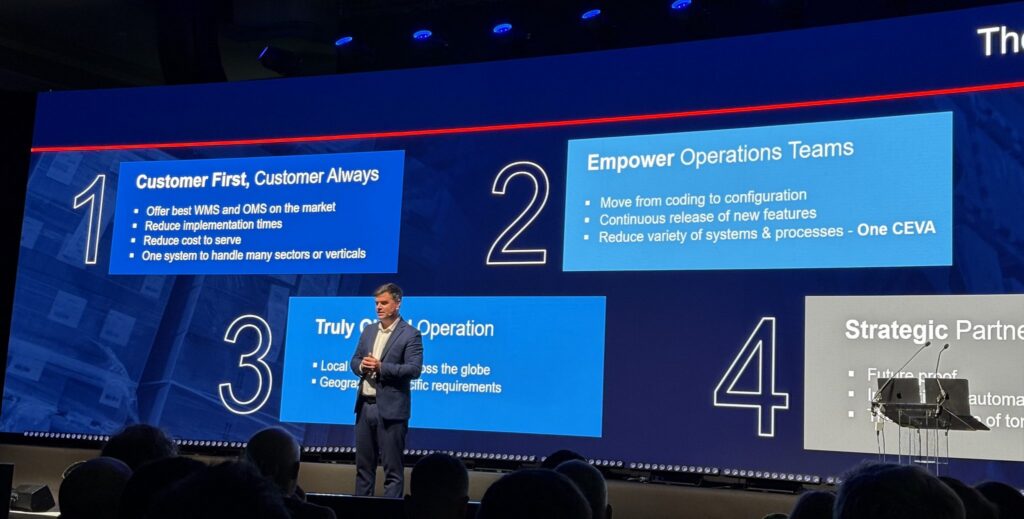
Customer examples illustrate the operational ambition. CEVA Logistics is working towards a global system across its distribution network, replacing a variety of inherited applications with a more consistent template. Asda introduced the platform during its separation from Walmart, changing its IT estate while distribution remained active. The retailer reports fewer than 500 monthly warehouse-management incidents and 100,000 fewer pedestrian journeys in its distribution centres.
Nespresso uses the platform to coordinate a supply chain spanning coffee production, automated Swiss plants and deliveries to 80 countries. For industrial companies, the wider lesson is that AI value depends less on adding another tool than on connecting reliable data, execution systems and carefully governed automation.
Manhattan says it refreshes much of its software code continuously, supporting what it describes as an AI-native platform. More information about the company’s technology is available from Manhattan Associates.