Omni-channel Automated Warehouse

40km northwest of Stockholm is the site of an innovative logistics centre. The food retailer Axfood and its partner WITRON designed and implemented a leading-edge omni-channel DC. It will supply 1500 stores and thousands of consumers from a range of 22,000 dry, fresh, and frozen items.
“Together with WITRON, we have implemented a system that sets standards in the logistics world due to its efficiency, quality, and cost effectiveness – and despite additional challenges such as the Covid pandemic and the war in Ukraine, it went into operation on schedule”, says Raymond Lundmark, Head of Logistics at Dagab, Axfood’s purchasing and logistics company. “All parties involved in the project can be very proud of this. We have shown what is possible with passion and outstanding teamwork,” agrees WITRON Project Manager Holger Weiß.
It is uncommon for WITRON to speak with such admiration about a project that is ‘functionally extremely demanding.’ But when Weiß talks about ‘his’ Axfood logistics centre, the scale of the implemented task becomes clear. “We have never seen such an interplay of systems, IT, and mechanics of this magnitude and intensity. We are experiencing omni-channel logistics at its best and in terms of business process integration, it is the most challenging project in our history to date.”
Impressive Figures
The figures are truly impressive: 103,000 square meters of logistics space, more than 22,000 different products – frozen pizza, fruits, vegetables, convenience products, sausages, meat, bread, cheese, pasta, cosmetics, and toys are stored in temperature zones ranging from -26 degrees Celsius to +18 degrees Celsius. More than 1.6 million picked units leave the DC every day.
Three years ago, the facility had not yet been completed. Nicholas Pettersson, the former president of Dagab, was already certain: “WITRON will make our vision of an omni-channel warehouse come true.” He and his team travelled around the world, looked at many reference solutions, and finally awarded the order. “We were very pleased with the statement and, to be honest, we also felt a bit of pressure,” laughs Weiß who, as the responsible project manager, supported the project right from the design phase.

Axfood is the second-largest food retailer in Sweden and has repeatedly faced capacity problems in the logistics area in recent years due to its growth. “The existing warehouses, especially the manual ones, were permanently operating at full capacity,” explains Lundmark. Axfood wanted to establish a long-term strategic position for the future. This also included safeguarding growth and meeting their own demands for high quality in logistics in terms of customer service across all different distribution channels. Omni-channel was the buzzword.
Same Automated Warehouse Technology
The online business has access to the same inventory as the store business. Processes that would have to be handled in two separate sectors and subsequently consolidated with conventional warehouse logistics at great expense are now managed in a single integrated warehouse logistics system. The result is significant efficiency, performance, and quality increases of the picking and packing processes as well as considerable investment savings. At WITRON, this is referred to as OCM.
“OCM stands for the integration of all horizontal and vertical players in an omni-channel network – encompassing suppliers, logistics centres, transportation, and the various distribution channels such as stores, home delivery, click + collect, and drives,” explains WITRON CEO Helmut Prieschenk. The objective is to create a high-performance, end-to-end retail logistics network where all nodes communicate with each other continuously and optimize each other. “The decisive factor here is that this project was not a pure automation or supply chain project, but a corporate transformation project. Consequently, the concepts of parallel worlds and self-sufficient silos are no longer viable options. The current focus is on achieving comprehensive cross-company optimization. Based on this, Axfood’s project goals – high cost-efficiency, high delivery reliability, best delivery quality, and assortment expansion – can be implemented ‘end-to-end’ across the group,” he adds.
Closely Interlinked
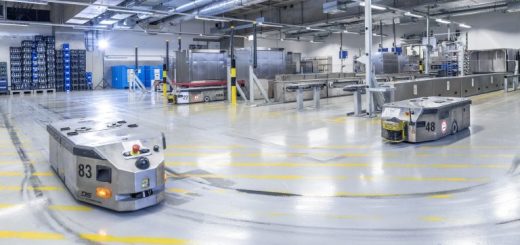
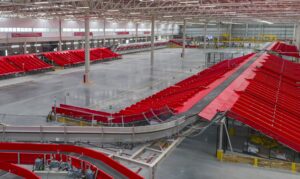
WITRON implemented a module mix that is closely interlinked: the OPM for classic store delivery, the CPS for large-volume and bulky goods, and the AIO in the small parts warehouse. In addition, a fully automated shipping buffer optimizes the entire shipping process in the store on a just-in-time basis. A sophisticated solution was also found for preparing e-commerce orders for dispatch. Here, the totes are sorted and stacked fully automatically by a route sequence buffer immediately after picking, allowing a shipping employee to load them into the respective trailer in a route- and sequence-friendly manner.

Depending on the respective distribution channel, deliveries are made using a variety of load carriers including store-friendly packed pallets and roll containers, frozen food containers, totes, specially developed freezer-compatible delivery boxes, and environmentally friendly paper bags. Innovative algorithms ensure efficient consolidation from the various product and temperature zones for each store or online order, as well as space-saving stacking onto or into the optimal shipping container.
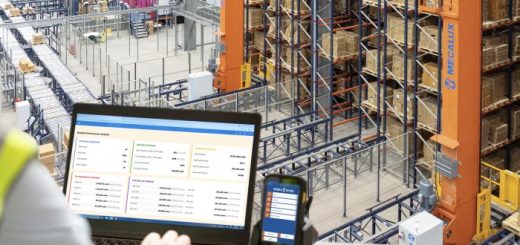
The new DC provides more than 700,000 storage locations for wooden and plastic pallets, roll containers, totes, and deep-freeze containers. It is also equipped with more than 200 stacker cranes and 30+ km conveyor technology – all controlled by a multi-functional warehouse management system with open interfaces extending from the WMS to the customer’s supplier systems, route scheduling and sales systems. A WITRON OnSite service team with more than 200 staff members ensures a permanently high availability of all components and processes in multi-shift operation around the clock.
Deep-freeze sector
The numerous different load carriers presented a significant challenge, particularly within the frozen food sector. “We also developed a new load carrier along the way,” Lundmark says. A novel tote system for the purpose of cooling frozen goods in e-commerce orders has been developed. This system utilizes specially insulated totes and frozen lids that serve as cold packs, replacing the conventional use of dry ice. These lids are pre-cooled in the warehouse for two or three days in special freezing zones and then automatically placed onto the totes. After delivery, the lids and totes are returned, refrozen, and re-used. “Many e-commerce companies avoid the handling of frozen goods as they do not know how to solve the problem. Now, we have a solution that is also very efficient economically,” explains Lundmark.
But what happens in Bålsta when an e-commerce customer orders frozen peas, chocolate, and shower gel? “Consolidation takes place in special route sequence buffers, where the totes are sorted and stacked fully automatically immediately after picking, before they are delivered to the end customer,” explains Weiß. The process entails online ordering → distribution according to temperature zones → order picking (where the appropriate part of the order is picked separately in the respective temperature zone) → consolidation in the route buffer → automatic sorting according to shipping routes → loading → delivery.
Technology and Culture
Fine-tuning the material flow is a typical final task in a project, but one that is particularly important. “No one has ever implemented a project of this magnitude and functionality before and there are few comparable ones in the world,” Lundmark states. “This only works if you work closely together as a team, think in terms of solutions and master challenges together. It was a very satisfying experience to implement the project together. As a strong partner, WITRON has the necessary know-how and decades of experience to successfully implement a project of this magnitude. Their corporate culture aligns seamlessly with our own, which I believe is a pivotal factor in the successful execution of this ambitious logistics initiative. Technology and culture must fit together.”
The project’s commencement coincided with the onset of the Covid pandemic, followed by supply chain disruptions due to bottlenecks in automation components. These challenges were further compounded by the conflict in Ukraine, resulting in further disruptions to supply chains. “Despite the challenges, we successfully managed all of these tasks and went live on schedule,” says Weiß. ”We can state with great pride that the project goals we set ourselves in terms of service level, efficiency, and sustainability have already been more than achieved. We have set a new standard.”