Hubtex engineers a coordinated vehicle fleet for deep repository operations
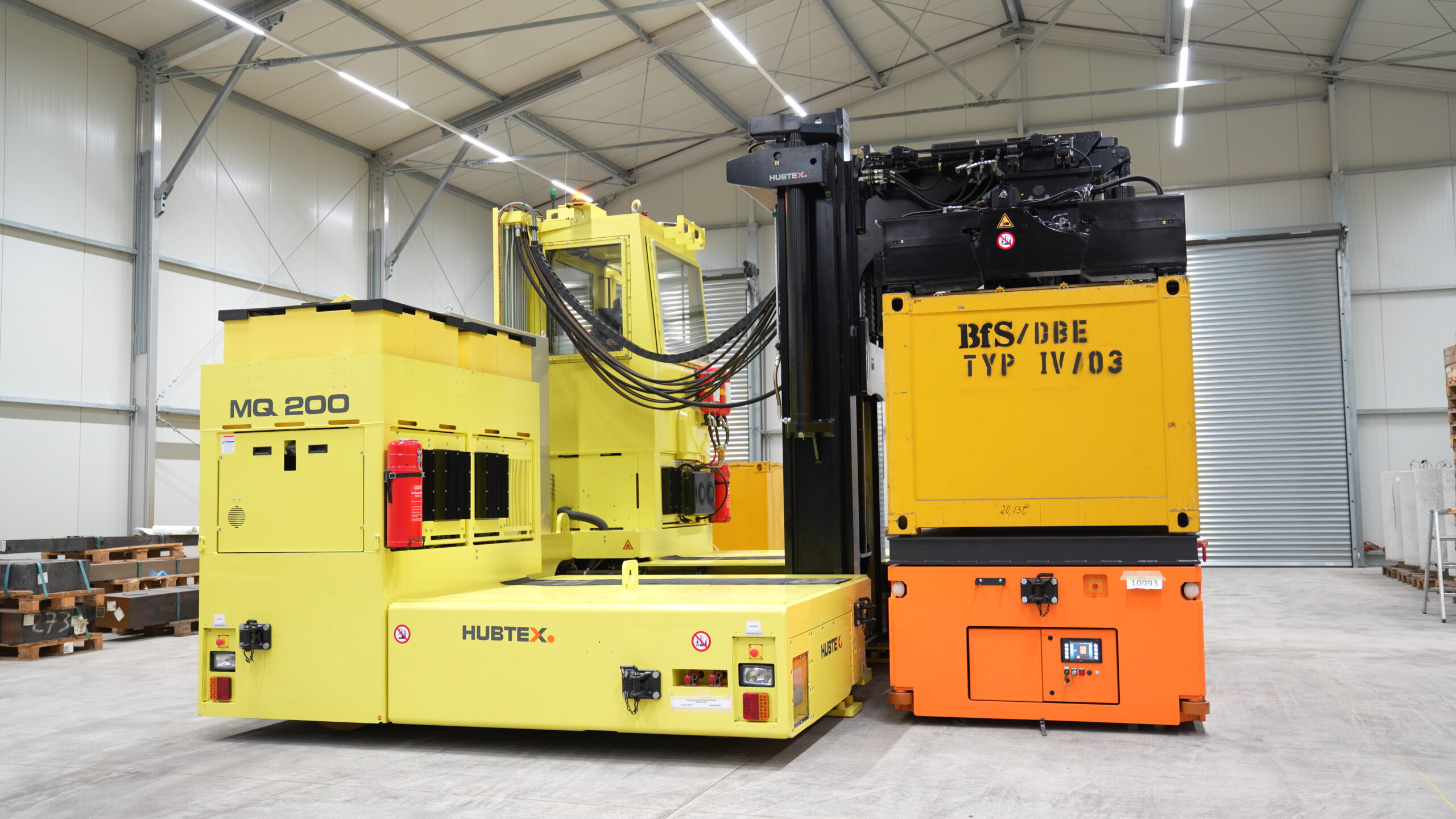
Germany’s Konrad repository will use a purpose-built fleet of five Hubtex vehicle types to manage material flows in one of the country’s most demanding industrial environments. The vehicles are designed for a coordinated sequence that begins with above-ground handling and continues to the accurate placement of low- and intermediate-level radioactive waste around 850 metres below ground.
The fleet will also move fresh concrete and pump-delivered concrete required to backfill storage areas. Several of the larger vehicles must be separated into components before being lowered into the underground facility, then rebuilt on site. Their inspection and documentation history must remain continuous throughout that process.
Engineering the complete transport process
Hubtex found no standard vehicle able to meet the combination of narrow routes, gradients, substantial weights and defined transfer procedures. The design brief also includes radiation protection, decontamination, fire-load limits, collision prevention, fall-height control and operator safety.
Rather than developing isolated machines, the company analysed routes, transfer interfaces, loads, environmental conditions and hazards as one operating system. The resulting vehicle architecture combines specialised chassis, steering, lifting and protection arrangements. Depending on their role, vehicles may include shielded cabins with lead glass and steel walls, protected ventilation, fire detection and suppression, emergency steering, position sensing, optical guidance, load tracking and communications.
These functions are intended to make every movement controllable and traceable, particularly at defined handover points where different vehicle types interact. As Hubtex project engineer Frank Knurr explains, the central challenge is integrating mechanics, safety systems, transfers and process monitoring from the beginning.
Verification built into production
The project’s controls extend beyond final assembly. Drawings, calculations and inspection plans define how each vehicle is designed, built and tested. Changes require assessment and approval, while the final records document the equipment actually manufactured and tested.
Materials, welds, assemblies and installations are checked during production under defined inspection plans. Hubtex quality personnel work alongside BGE representatives and an independent expert where required. Welding qualifications and non-destructive testing provide further assurance for specialised materials, thick sections and critical joints.
For industrial operators, the project illustrates how bespoke vehicles can support hazardous, heavy-load logistics when automation, safety engineering and long-term traceability must function together rather than as separate features.