




Warehouse operators may own enough handheld scanners to support a shift, yet still leave employees searching for a working device. The reason is often simple: workers keep the equipment they trust in personal lockers so it will be available the next day.
This is not necessarily misconduct. When reliable kit is difficult to obtain, retaining it becomes a rational response. The operational cost appears in lost minutes as colleagues walk the site looking for functioning equipment, while usable scanners remain outside normal circulation.

Hidden assets create visible costs
Conventional asset records tend to classify devices as either available or lost. A scanner stored in an employee’s locker fits neither category. As a result, businesses may write off equipment that is still on site and being used, while also purchasing replacements unnecessarily.
One retailer reportedly allocated a six-figure annual budget to replacing missing handhelds. After changing its issue-and-return process, it no longer needed those replacements. A similar principle applies to lower-cost tools. IKEA found that missing tape measures and safety knives could prevent packing work from starting; the disruption mattered more than the purchase price.
The issue also crosses departmental boundaries. IT may fund handhelds, but warehouse management absorbs the productivity loss when a shift begins without sufficient equipment.
Automation changes the behaviour
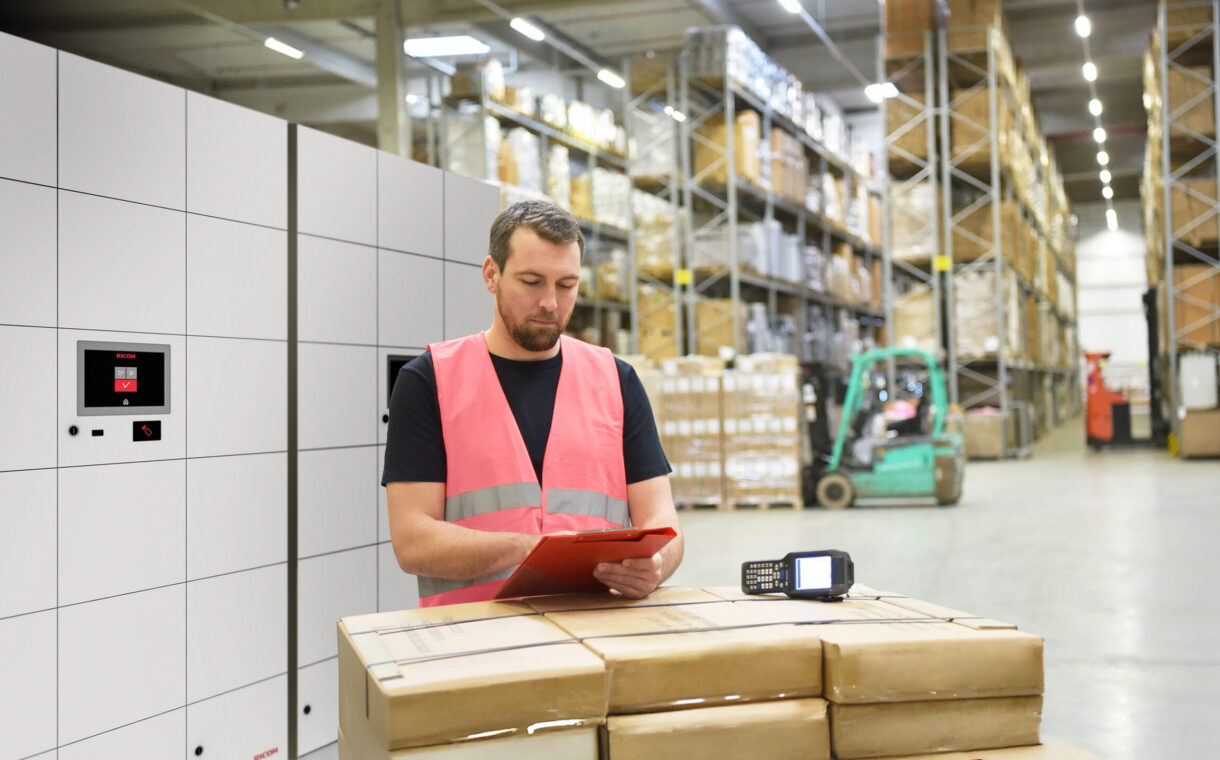
Smart lockers can issue devices according to usage, rather than allowing the same popular units to disappear repeatedly. This distributes wear across the fleet and gives newer equipment a fair chance to enter service. Workers can also report a fault while returning a scanner, preventing the next user from unknowingly collecting defective kit.
Location is important. Next has placed lockers around its distribution centre so employees can collect and return devices near their work areas. Shorter walking distances reduce start-of-shift delays and remove one of the practical reasons for taking equipment away.
For industrial companies, the locker itself is only the visible component. The larger opportunity lies in automated allocation, traceability and timely maintenance. Further information on Ricoh UK’s smart locker services illustrates the technology behind this approach.