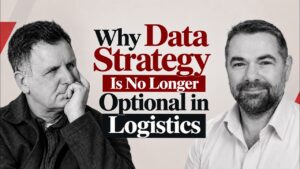
Logistics Faces a New Challenge: Turning Data Into Decisions

Logistics companies are gathering more information than ever, but greater visibility does not automatically produce better operational decisions. As artificial intelligence, automation, sensors and connected platforms expand across the sector, businesses face a new challenge: managing the information generated by their own digital infrastructure.
That challenge was discussed by Robert Jordan, chief executive of iFactory, and Paul Hamblin during a recent episode of Logistics Business Conversations, recorded at Parcel & Post Expo in London. Jordan described the risk of creating a “data junkyard” — a growing store of information that is collected, retained and eventually overlooked.
More information, not necessarily more insight
For parcel and logistics operators, data can come from transport systems, warehouse equipment, customer interfaces, tracking devices and automated processes. Each source may improve visibility in isolation. However, when information is duplicated, poorly structured or disconnected from daily workflows, its value can diminish.
The discussion raises a practical question for industrial companies: which data is essential for decisions, and which data is merely accumulating? Organisations may possess commercially valuable information without having a clear method for finding, validating or applying it.
AI increases the stakes
Artificial intelligence makes data strategy more urgent. AI systems depend on reliable information, while business users need confidence that sensitive or important records are stored, governed and used appropriately. Questions about ownership, retention and security become harder when data moves between multiple business systems and automated tools.
Jordan and Hamblin also considered the relationship between technology and human judgement. Automation can accelerate processes, but it does not remove the need to define useful outcomes or decide which signals deserve action. The operational goal is therefore not simply to become data rich, but to become decision rich.
That shift has implications for profitability and resilience. Companies that organise their information around specific operational choices may respond faster and use automation more effectively. Those that continue collecting data without a clear purpose risk building complexity instead of capability.
For logistics leaders, the immediate task is to review what information the business holds, how it is used and what happens when it is no longer actively needed. The question is no longer whether the sector will generate more data. It is whether that data will improve the next decision.