




Industrial labelling is moving beyond the traditional priorities of print speed, robustness and uptime. As warehouses connect more systems and respond to tighter traceability and regulatory requirements, the label printer is increasingly part of the site’s digital architecture.
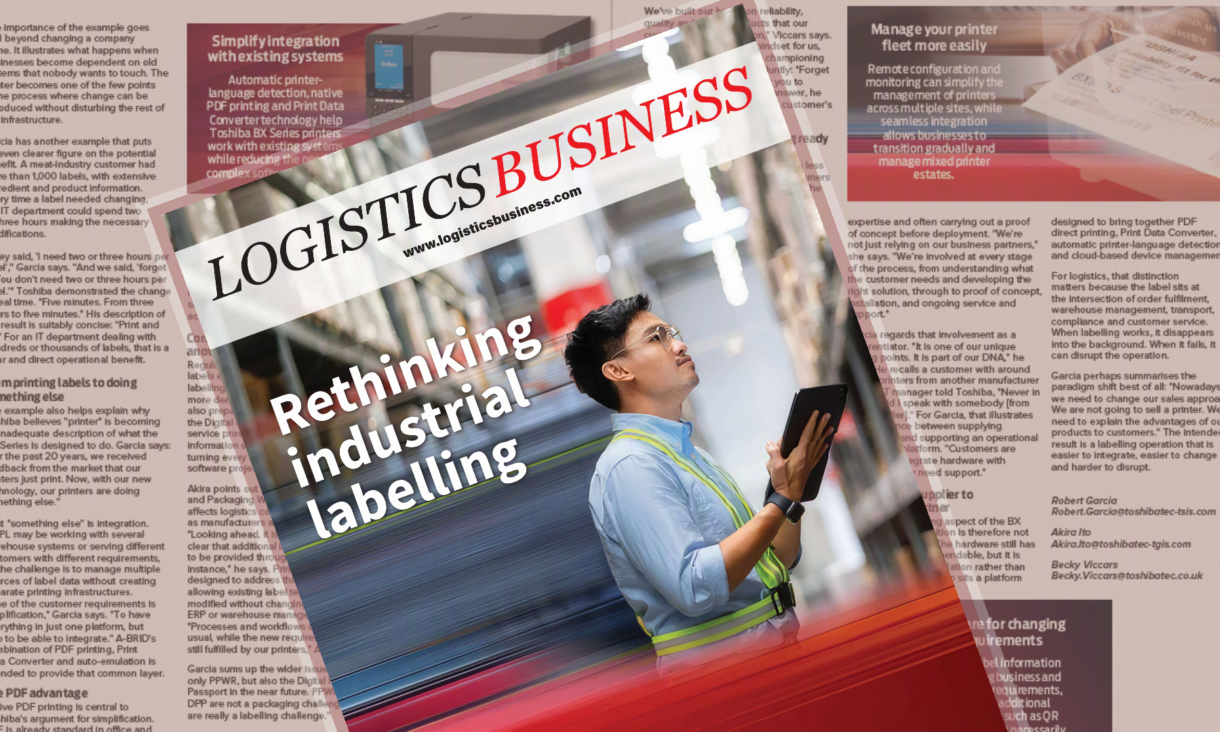
A new eBook, Rethinking Industrial Labelling, produced with Toshiba Tec, examines how printing technology can help industrial operators simplify workflows and respond more quickly to operational change. The publication features Logistics Business Editor Peter MacLeod in discussion with Toshiba Tec specialists.
Integration becomes central
One of the key issues is the relationship between printers and the systems that generate label data. Warehouses may need to connect several warehouse management platforms while accommodating changing product, customer and compliance requirements. In that environment, a printer that simply accepts a fixed command language can create additional configuration work.
The eBook explores native PDF printing and automatic detection of printer languages as possible ways to reduce integration complexity. These capabilities are presented as tools for making deployment and ongoing administration less dependent on bespoke adjustments.
Faster change, lower consumption
The operational effect can be significant when label designs change. One example in the publication describes a modification process that once required as much as three hours but was completed in five minutes using a different approach. The material also discusses technology that can cut ribbon consumption by up to 75% in applications where the method is suitable.
These developments matter because labelling sits at the intersection of automation, inventory control and outbound execution. Delays or errors can affect several downstream processes, while excessive consumables add avoidable cost.
The wider message is that industrial printing should be assessed as part of the warehouse technology stack. For companies facing more variable demand, higher data requirements and pressure to improve efficiency, adaptable labelling infrastructure may offer a practical route to more resilient operations.