




Linde Material Handling is expanding its warehouse automation portfolio with two systems designed around incremental growth. The Linde S-MATIC cube automates pallet storage, while the S-MATIC bin combines robotic bin retrieval with mobile robots for small-item picking.
The common principle is modularity. Operators can add storage positions or robot capacity as demand develops, rather than sizing the entire installation for a future peak from the outset. That approach is relevant to e-commerce businesses, logistics providers and manufacturers modernising existing buildings with variable throughput requirements.
Four-way pallet movement
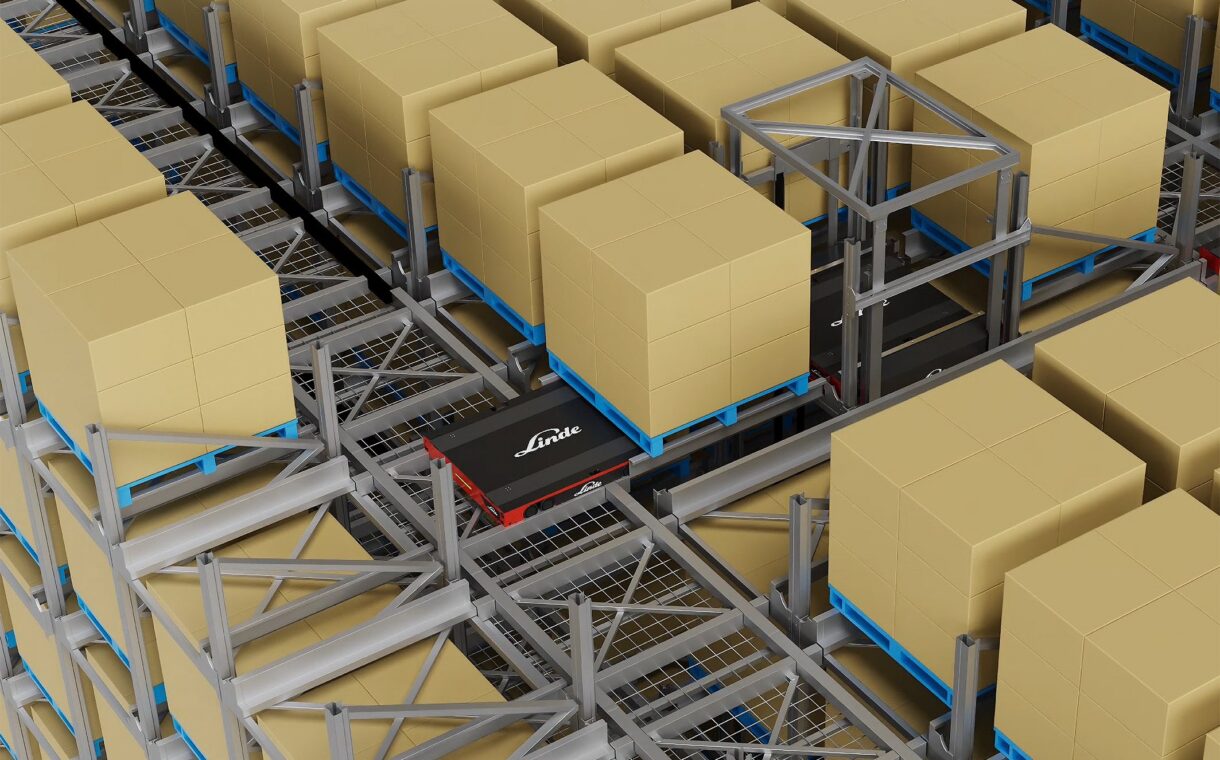
The S-MATIC cube is designed for pallets weighing up to 1,500kg. Four-way shuttles move loads horizontally within rack levels, while two-way shuttles provide vertical movement. Because the shuttle mechanism occupies the footprint of one pallet, the system does not require conventional lift infrastructure in every storage section.
Capacity grows through additional channels; throughput can be increased separately by deploying more shuttles. The self-supporting rack structure needs a standard concrete floor and can be installed in facilities with ceilings of about eight metres. Up to ten levels are possible in that configuration, while project-specific designs can reach 40 metres.
Dense storage may also benefit temperature-controlled operations by reducing the air volume that must be cooled in deep-freeze environments. Redundant equipment architecture is intended to keep the installation operational during maintenance or replacement of individual shuttles.
Linde Warehouse Manager software selects pallet locations using AI-based algorithms and connects with ERP and warehouse management platforms. Pallets can move to production or picking areas by conveyor, industrial truck or AMR, including an arrangement in which elevated racking allows robots to collect loads underneath.
Flexible small-item fulfilment
The S-MATIC bin uses robots to retrieve containers from racks up to 12 metres high and mobile bin movers to deliver them to workstations. Avoiding fixed conveyors allows routes and workstation layouts to change more easily. Bins can be stored up to five deep, while workstations support bin-to-bin picking, replenishment and mixed bin-and-pallet processes.
Depending on the design, a workstation can process 400 to 600 order lines per hour. Linde states that the system can raise capacity by as much as 300% compared with manual operations. Mobile units travel at up to 4.5 metres per second and can run for up to 11 hours per charge, handling cartons, containers and trays up to 800 by 600mm. More robots can be added when order volumes rise.